Notice: This is a proposal only. Nothing described here is currently in effect. Volunteers and community members are welcome to help advance this proposal.
Data & Research
The Alabama Prison Reform Proposal is built on official state data, independent fiscal analysis, and federal findings about prison conditions in Alabama.
ADOC Reports
The Alabama Department of Corrections (ADOC) publishes monthly and annual statistical reports that reveal the scale of overcrowding, violence, and system strain. Key findings:
Overcrowding:
As of August 2025, ADOC’s in-house population was 21,121 people held in facilities designed for 12,115 beds—about 174% of capacity.
Growing population:
The jurisdictional population increased from 27,428 (Aug 2024) to 28,246 (Aug 2025)—a 12-month increase of 818 people.
Admissions vs. releases:
ADOC recorded 9,977 admissions and 9,167 releases in the 2025 YTD period in the August report—showing more people entering than leaving the system.
Per-day cost & programs (FY 2021 example):
Total annual expenditures reached $650 million, with an average system-wide cost of $82.64 per inmate per day.
Education & program completions
From just one recent year (FY 2021), ADOC reports:
Re-entry programs completed: 481
Drug treatment programs completed: 802
GEDs earned: 18
Vocational education certificates: 712
These numbers show that some programming exists, but is vastly underscaled relative to the system’s size and needs.
Analysis
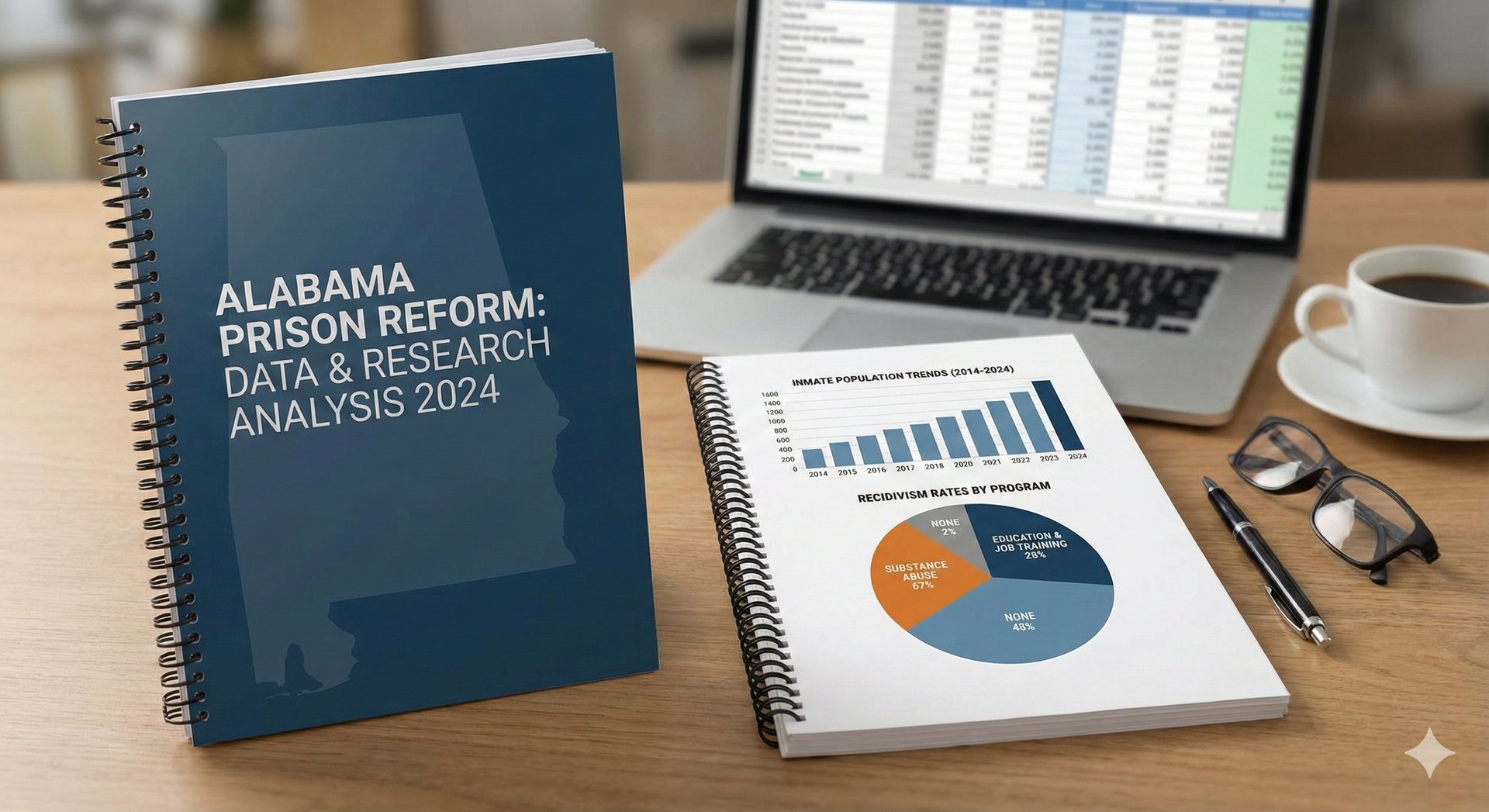
The chart “ADOC By The Numbers” shows that from 2021 to 2024, Alabama’s prison population remained consistently high, ranging between 19,978 and 23,052, with no significant decrease despite billions in state spending. In contrast, participation in rehabilitation and reentry programs stayed much lower than in the overall population. Career and Technical Education completions fluctuated from 712 in 2021 down to 532 in 2022, then rose to 1,231 in 2024, a figure that still accounts for less than 7% of the incarcerated population. Drug treatment completions followed a similar unstable pattern, shifting from 676 to 1,141, showing limited access to substance abuse services across the system. Pre-treatment and aftercare programs—which are crucial for successful reentry—fell sharply from 1,138 in 2021 to only 822 in 2023, with a modest rebound to 983 in 2024. Overall, the data reflect a system where mass incarceration dominates under-resourced rehabilitation efforts, resulting in a continuous mismatch between the number of people incarcerated and those receiving education, treatment, or reentry support. This imbalance highlights the urgent need for structural reform, expanded program capacity, and a shift from a warehousing approach to a rehabilitation-focused system.
Alabama by the Numbers
Alabama Appleseed’s fiscal analysis reveals that Alabama has committed more than $5 billion in just five years to its prison system when combining ADOC’s operating budgets, new prison construction costs, and debt service obligations. General Fund appropriations alone have climbed sharply—from $610.7 million in FY 2022 to a projected $826.7 million in FY 2026—making corrections one of the fastest-growing segments of the state budget. This massive investment is compounded by the state’s $1.3 billion authorization for new megaprisons, including the 4,000-bed Elmore facility, which carries a per-bed cost approaching $300,000—more than the average Alabama home. These expenditures do not include the $57 million drawn from the state’s liability fund to defend ADOC against lawsuits involving prison conditions. Both Alabama Appleseed and the Alabama Reflector highlight a troubling trend: while corrections spending has surged, funding for prevention-oriented agencies—such as mental health, public health, and human services—has grown far more slowly, resulting in these critical services receiving a shrinking share of the General Fund.
For years, Alabama’s prison system has been under federal scrutiny for unconstitutional conditions, with repeated findings of chronic overcrowding, severe understaffing, high levels of violence and sexual assault, and dangerously inadequate medical and mental health care. Rising ADOC budgets have largely been driven by staffing demands, mounting legal costs, and the state’s attempts to respond to federal court orders and ongoing litigation. Yet despite escalating spending, Alabama’s prisons remain among the deadliest in the nation. In 2023, ADOC reported 335 deaths in custody—including at least 14 homicides and 101 drug overdoses—and in 2024 the system recorded 274 deaths, still one of the highest mortality rates in the United States. Monthly ADOC reports consistently document high levels of violence, disciplinaries, and medical emergencies, underscoring that increased funding has not translated into improved safety for either incarcerated people or correctional staff.
Even within this troubled system, program data show promising results where Alabama does invest in rehabilitation. According to ADOC’s FY 2021 report, 481 people completed reentry programs, 866 completed drug treatment, and the Alabama Therapeutic Education Facility (ATEF) graduated 230 participants, including 148 vocational certificate earners through its partnership with J.F. Ingram State Technical College. These outcomes demonstrate that evidence-based programming works—but remains dramatically under-scaled for a system incarcerating more than 20,000 people.
The Alabama Prison Reform Proposal uses these data to identify priority areas—overcrowding, violence, lack of treatment, limited educational access—and to model the cost-benefit of solutions that shift the system from warehousing to rehabilitation. Our Revive → Rehabilitate → Rebuild → Restore → Release framework is grounded in transparent metrics, measurable outcomes, and continuous accountability. The same data tools used to diagnose the system today will be used to track progress tomorrow, ensuring Alabama invests in what actually increases safety: education, mental health treatment, reentry preparation, and community-based supports rather than unchecked incarceration spending.
Why Reform Makes Alabama Safer
Alabama’s prison crisis does not just affect the incarcerated—it touches every community, every victim, and every taxpayer. Meaningful reform creates a safer state by reducing violence, preventing future crimes, strengthening families, and restoring true accountability. Evidence across the nation shows that rehabilitation, education, and structured reentry programs significantly reduce violence inside prisons and sharply lower recidivism after release. States that invest in correctional education see reoffending drop by up to 43%, cognitive behavioral therapy reduces violent behavior, and vocational training programs cut the likelihood of returning to prison by 20–30%. Systems that improve prison conditions experience fewer assaults on staff, fewer homicides, and more stable facilities overall. This matters profoundly for Alabama, where prisons have some of the highest rates of violence and death in the country. Evidence-based programming is not leniency—it is crime prevention, officer protection, and a proven pathway to safer communities. Reform also brings significant economic benefits. Alabama currently spends billions on a prison system that produces little public safety return, while reform reallocates resources into strategies that save money and strengthen communities by reducing medical emergencies, cutting legal and compliance costs, lowering reincarceration expenses, and building a job-ready workforce. Every individual who leaves prison with education, treatment, or a recognized credential costs taxpayers far less than another year of incarceration and is far less likely to reoffend. Reform is not merely a cost—it is an investment with measurable returns. Finally, real public safety is impossible without victims at the center. Victim-centered reforms expand restorative justice pathways, require accountability and harm acknowledgment, reduce prison chaos that endangers the public, and improve restitution and communication systems. Survivors consistently report that what they want most is prevention, accountability, and safety—not endless cycles of violence. Reducing reoffending is the most direct way to protect victims from further harm. A safer Alabama will not come from building more prisons; it will come from building a better system—one grounded in evidence, economics, and victim-centered justice, designed to protect families, reduce crime, and strengthen every community in our state.
Stay Updated
Get the latest news on Alabama prison reform
GET INVOLVED
© 2026. All rights reserved.